


 subscribe
The Independent newspaper today has a review of the Laurie Anderson performance we all went to. What strikes me as a bit odd is that the reasons the reviewer gives for not liking her performance too much at all are exactly the same reasons why I actually enjoyed it very much.
 |
So, for example, he criticises her for having a certain mannerism in the way she delivers her text. But the 'buts' and 'ands' with which Laurie starts her sentences are part of the way Laurie does things and has always done things. Thats part of her very personal technique of delivering her lyrics. Love it or leave it, but thats her style.
The reviewer, a certain Robert Hanks, also dislikes the way she juxtaposes kind of cosmological NASA passages with parts which zoom in to the very private earthly life of people, or her dog, Lolabelle (great name). But thats exactly what's so great about the piece. NASA scientists - and many other scientists too - love to lecture us non-scientific nobodies about earth shaking discoveries in, for example, quantum cosmos information theory, theories that are truly far out and weird. But what should us common earthlings now make out of all of that? Laurie brings NASA down to earth, she shows exactly the other side of the coin, the very earthly, mundane kind of life that we all have to deal with. Because in the end, this is the only Earth we have, the place where we live, and where, if anything, we can and need to make improvements. Yes, luckily, so far, we hagve not been seriously interrupted by phantom energy. And if we have to wait 10.000 years to make Mars inhabitable then that gives us a good chance to focus on improving the quality of life beforehand -- and not destroying it, so that we have to emigrate.
Hanks also goes on about Laurie not always being very clear in her texts, like, ah, well, sometimes its hard to understand and does not make sense in a clear cut logical way. But, she is a poet, Mr. Hanks, an artist, she does not have to be a Science Studies writer (and, oh my god, do those science studies writers always make sense?). She mixes rationality with things that are not always so straightforwardly to be explained, images, breaks, metaphors, conjunctions. I think it is actually a great way in which she delivers her final report about her artist-in-residency at NASA. Who else could make such a difficult topic so enjoyable?
Last not least the Independent scribe also complains about Laurie Anderson being not as high-tech as she used to be. In the 1980s she stunned the world with large projections, interactive tricks, with, what then was not called new media but multimedia. Actually, she shaped the perception of what multimedia could be and by doing so inspired many people to get involved with this field, including me.
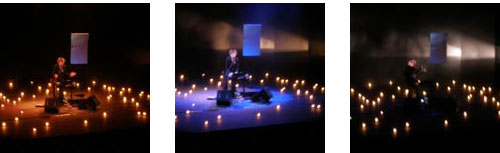
Now she comes across as a kind of unplugged version of herself. On the stage candles, an armchair, the Midi-keyboard, one small projection, on a screen that resembles the flipchart typically to be found in meeting rooms. She uses it to great effect in one short scene, with a small camera shooting herself playing the violin. It is, dear Independent reviewer, a quite deliberate choice of weapons, I believe. Laurie Anderson has done big, expensive, stunning multimedia before. She has nothing to proof in that regard. In doing the NASA show, how could she top herself? Because the theme of the show is so high-tech, she can go low-tech in the delivery. I think that is a genial move.
When Laurie Anderson was at her peak in the 1980s she was one of a number of New York artists playing with multimedia and at the same time inhabiting a kind of pop underground position with the occasional hit potential. Of those, most have been long forgotten or at least not much been heard of recently. It was good to see, on Wednesday night, that Laurie Anderson, as a survivor of that age when New York played the key tunes, has kept herself in shape and well and relevant still for this day and age.